I saw The Brutalist during last year’s TIFF in 70mm which was quite the treat, so when they announced there was another movie involving the same duo but with Mona Fastvold and Brady Corbet switching roles as director and writer, and that it would also be projected again on 70mm, I could not say no to that. I was unfamiliar with the Ann Lee story and the Shakers prior to this film, other than descrptions of the film being a musical which would be quite the departure from the style of The Brutalist.
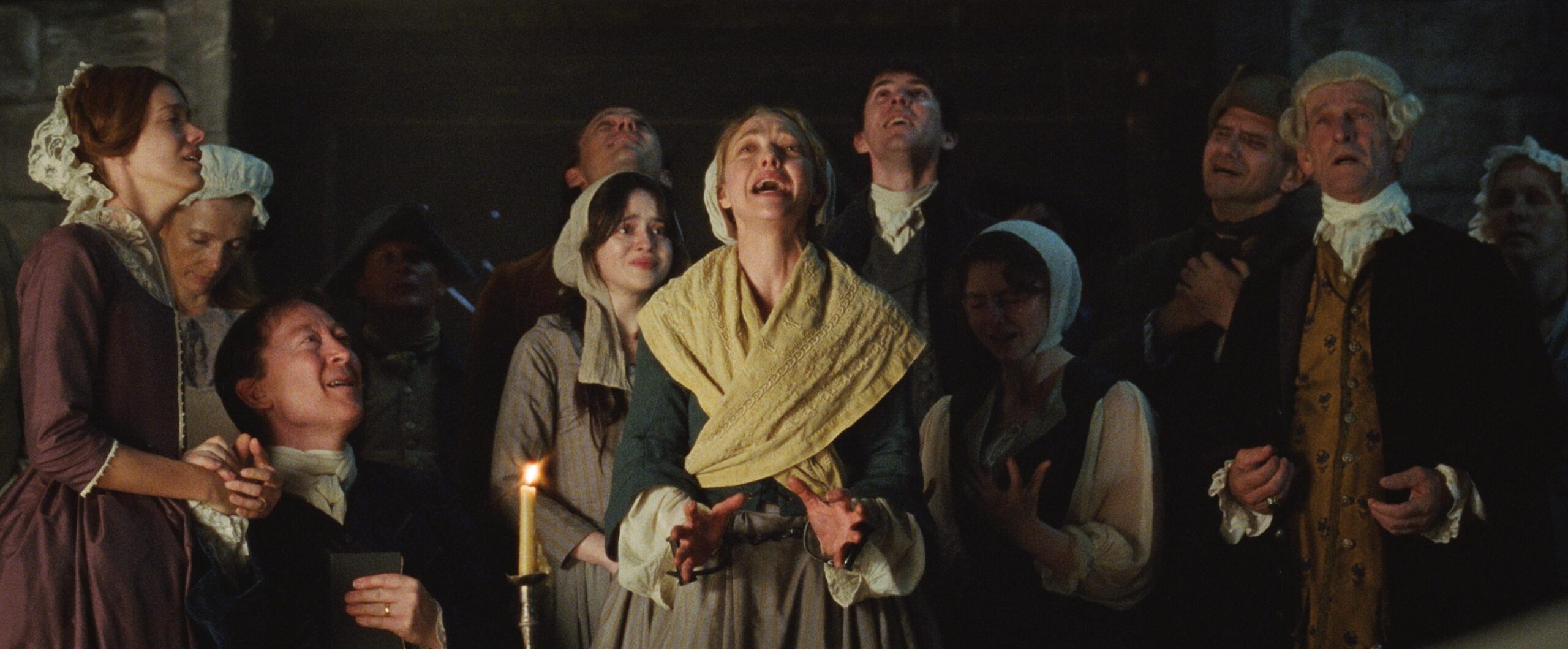
The film frames the story in quite a biblical manner, as if Ann Lee were a prophet herself much like how her devout followers probably would have viewed her. After losing all her children and getting in trouble one too many times with the authorities back in Britain, she travels to America for a fresh new beginning where she can go on the journey of converting others to follow her and to spread the gospel – such as the advocacy of celibacy brought about by Ann Lee’s own experiences. Sometimes she is met with some resistance, even among others who eventually come to doubt her. Sometimes the confrontation ends up with violent results. There is a very intense climactic scene near the end where during worship she and her followers are attacked by a mob. The experience is intense and traumatic as Ann Lee is stripped down and her brother and other followers whipped to death. She dies not too long after, unable to get over the loss of her brother.
The dancing and musical sequences for the most part were great and certainly lived up to expectations, chaotic and disturbing at points yet hypnotic and rhythmic. This seems to be in line with the way the real Shakers used to dance and worship – the body movements are so expressive. The vocal chanting was booming especially in the Lightbox cinema where I saw this – the music production would sound nice on any good stereo system, let alone a theatre. Some of the songs involving solo vocals by Amanda Seyfried for example didn’t do quite as much for me – her vocal range certainly isn’t bad, but wasn’t strong enough to carry a song of that magnitude with that kind of lush instrumentation and production. Those moments reminded me slightly of the Les Misérables film adaptation that Amanda Seyfried also starred in where I felt there were similar issues there concerning the vocals (as well as Hooper’s decision to record everything live – but that’s an aside).
The presentation of the story flowed more like a Wikipedia summary of Ann Lee in some respects as well as the founding of the Shakers movement itself. While there is a lot of resistance against her teachings and her followers, involving moments that would be very traumatic for just about anybody, for much of the film she is an unstoppable unwavering force. There is not much self-doubt within her, no need to question whether or not she is doing the right thing – she just knows and asks to trust her judgment even when her followers start to doubt her. It’s possible that perhaps the real Ann Lee may have been like this, but I also don’t know that it makes for a necessarily compelling human character. It’s less about analyzing the beliefs, the experiences and the choices Ann Lee makes or has along the way, but more about the journey itself from destination to destination. It’s less about assessing or ruminating on the aftermaths of the resistance she and her group have faced, and more about the revelations that come with using song or dance as a way to express and to relieve oneself of those burdens and struggles.
Ann Lee’s beliefs were quite feminist and ahead of the time especially as a woman leading a religious sect in a patriarchal society even if other aspects of the sect she founded no longer have relevancy today. So I understand the need to tell this story in this way even if the approach made it difficult for me to connect to her and the Shakers’ struggle beyond the surface of what she did and accomplished.