Blake Williams remains one of my favorite experimental filmmakers today. His use of 3-D and the exploration of this medium remains unique and unparalleled. He is his own one-man crew on many of his productions, oftentimes not just directing, but also sound, cinematography and editing. He may not have the budget or the means to compete with more commercial 3-D fare that Hollywood tends to churn out every now and then, but it’s more about the vision and ideas than the money, and in his case his ideas are vast. A lot of the appeal of his movies feels intuitive on the surface – I feel like you could show many of his films to an audience unacquainted with experimental cinema, and they may find themselves blown away by some of its details even if they may not understand where all of it is coming from (even for someone like myself). These two particular films – PROTOTYPE and Laberint Sequences – show why that is the case.
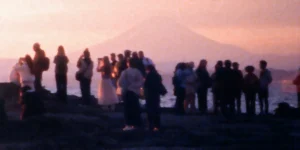
In PROTOTYPE, Blake Williams himself said during his Q&A that he was looking to explore the idea of cinema being a database, experiences not constrained by a timeline. There is a loose narrative going on that reinforces many of the images in the film, a personal one connected to Williams’ own grandparents and their village – although this is not something that can easily be inferred by the film itself. We start with photos of the 1900 Galveston hurricane aftermath, its devastation over the land. The film shifts to multiple analog TV screens, the only sources of light within the pitch black darkness. These screens start displaying other black-and-white footage, some foregrounded over others at the same time. There’s something haunting about looking at this assortment of footage in this way, with the people we see on these screens appearing like ghosts wandering around these various interiors. It gives the effect of peering through an old museum full of memories of people and things long gone if that museum was at the edge of the universe – in fact it is no coincidence that there’s also a shot here involving people wandering through a museum exhibit. The very images within these screens also contain so much endless depth within the three-dimensional space it’s like you’re peering out a window instead of watching a TV. I’m thinking in particular of one actual shot of clouds high up in the sky, framed through one of the TV screens as if you’re watching the clouds out of an airplane window. But it’s also more than that – some very trippy moments here involving black-and-white binocular rivalry that are very hard to describe using just words, with odd compositions – an off-centre close-up of a statue, tidal waves curving around the surface as if we’re watching them from the edges of Earth. The latter in particular seems to be the beginning of a recurring motif that would appear again in FELT.
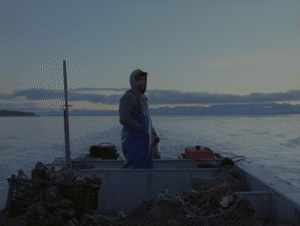
As for Laberint Sequences, it’s like if you could make many possible variations of a film about a certain topic – in this case, the subject matter being about navigating through a maze – except if you put all these variations together into one movie. What’s most impressive about it is that it’s only around 20 minutes long, and yet the film does so much with so little. Much of the film takes place in the Laberint d’Horta in Barcelona, as Blake Williams’ camera takes us through the maze, its plants and trees, its fountains and the tourists walking around. A lot of the camerawork is less about getting us to explore the physical dimensions of the space, and about getting ‘lost’ inside the maze itself, but rather about manipulating these dimensions and getting lost within those manipulations of the space. To illustrate, one such sequence feels like the image of the maze folding in on itself, like peering inside a 3D image within an angled planar surface bouncing around the screen. Later on the film incorporates footage from a much older 3D film titled The Maze involving two women trying to navigate a maze using a candle. Much of this footage is also manipulated, as we get a segment featuring Deragh Campbell who we see watching the footage and voice dubs the dialogue of the characters in replacement of the original recordings. There’s a moment where the outlines and silhouettes of the picture slowly disintegrate through flashing bright colours and lights, a very cool effect if a little hard to describe in words. Tons of layers of foreground and background here as far as the 3D is concerned that feels so incredibly immersive and would make James Cameron eat his heart out – note the shots of the fountain and the appearance of the depth of water and the objects in it (very Godard).