The screening of Concrete Turned to Sand that I was at was preceded by Lindsay McIntyre’s short film Tuktuit: Caribou. I was made aware of McIntyre’s work previously as an analog experimental filmmaker working in Canada, but this was my first introduction to her work. Her short film was quite lovely and beautiful. Filming Nunavut with its landscapes in a way that feels simultaneously alien (especially with the composites of dual landscapes, one floating in the sky above the other), yet spectacular at once. I admittedly would have to watch this again in order to understand how the narration connects to the wider themes of the movie as a whole, but it still made for a very visually engaging watch. It was made even better knowing and understanding how it was made – that the lichen and caribou hide that is presented in the film is the very sort of thing that was also used to make the emulsion itself as part of the solution for processing the film.
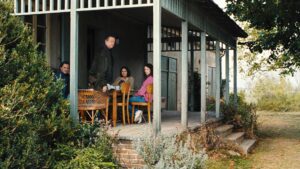
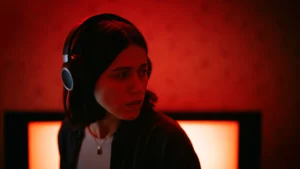
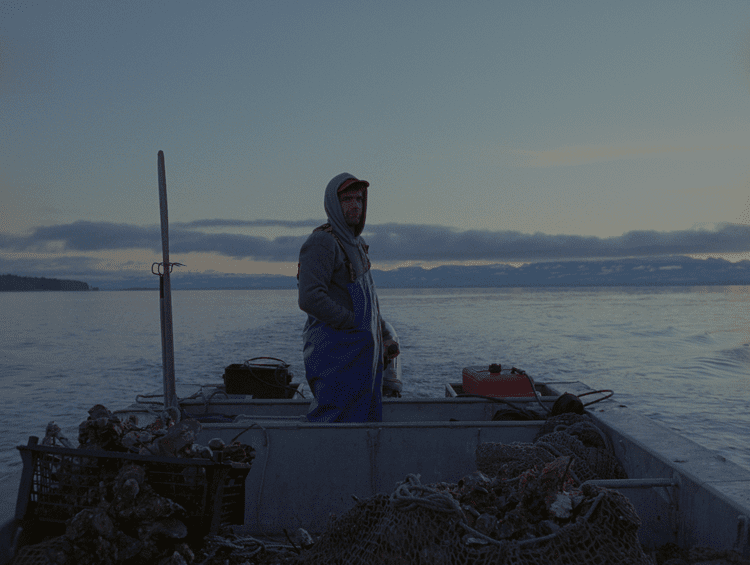
In a way, the short film makes for a great accompaniment to Concrete Turned to Sand, as both films deal with the vast landscapes and biodiversity that defines Canada’s own geology and ecology, even if both films take place in different regions of Canada. Concrete Turned to Sand in particular focuses its attention off the coast of B.C., towards islands like Vancouver Island, but more specifically Cortes Island. Much of the film’s short 73 minute runtime is devoted to observing the mundane routines of oyster farmers. We see the different methods of catching oysters either by the use of strings via tugboat or by hand just off the coast. There is also another segment devoted towards scientists researching and observing the oysters that are caught within the region. Throughout the entire film, audio interviews are interspersed both with the oyster farmers and the scientists. The oyster farmers speak of their lives describing what they do – one such audio snippet contains an amusing anecdote of one of the farmer’s colleagues who he calls an excellent oyster farmer who also partakes in fistfights at the nearby 7/11. The interviews with the scientists detail concerns with regards to ecological and climate change and their impacts on the oyster populations, sometimes going into some finer scientific details regarding monitoring the pH levels within what is described as the intertidal zone that is home to these oysters and many other such organisms.
The film does take on a very slow pace – the editing does not cut back and forth a lot and lets the cinematography speak for itself with its long-takes. I quite particularly enjoyed some of the shots that point towards the water – particularly the opening shot, as well as those segments where the dark and pitch black landscapes start to blur and merge together with the sky and the water beneath, like oil paintings. There is something to highlighting the very mundane and repetitive nature of oyster farming with this more patient approach – it’s slow, yet peaceful. But it does feel at odds to have these two subject matters co-exist within a film this short – both the simplistic lifestyle of oyster farming and its environmental concerns. As a result, it does feel like neither topic gets fully explored as it should. The mundane ritual of oyster farming just only is what is there without any further examination into these farmers’ lives, and the environmental concerns don’t extend beyond the short interview segments throughout the film. The interview snippets with the scientists are told in such a dry, technical fashion that it’s hard to have any emotional connection to their words especially for the average non-scientific layperson. The film embodies no urgency when it comes to the latter topic given that the film is just as slow in highlighting the subject matter. It should have either stuck to the farmers’ lives and their routines or taken on a different form for its environmentalist stance.