There has been a lot of effort from director Boots Riley himself to try to get people to see his latest film, I Love Boosters. See it opening weekend or “ITS GAME OVER FOR I LOVE BOOSTERS“, posted by Riley himself on X. His other suggestion: do not wait until June to see this, for it will be out of theatres by then. Understandable, considering the current structure behind how films in Hollywood get made these days – in a sea of endless remakes, sequels and adaptations of big properties, an original story like I Love Boosters has become increasingly rarer and harder to find. Such films often get little to no promotion given the expenses that would be involved in promoting a film like this with no guarantee of a return on investment, are dumped onto streaming not that long after its theatrical release without recouping the budget and end up discouraging investors even more, perpetuating the current cycle.
Boots Riley himself is aware of this. Quoting a recent interview from the San Francisco Chronicle, he states: “The economic pressure is even more through the roof… So I’m trying to make films that give people hope in terms of what we can actually do to change the way things are. I try to make optimistic films that aren’t just fantasy, they’re connected to the fact that there is a way for us to affect power.” He may be against the capitalist societal structure that governs the North American world, but he himself will tell you that real change comes from affecting change within the system, not to go against it. The approach, then, is to use film as the means to affect such change – to connect with audiences through the power of entertainment rather than to endlessly rant on and on about Marxist politics. In summary, the late-stage capitalist system is what funds a movie like I Love Boosters (or at least all $20 million of its budget), and Riley is encouraging you to spend your hard-earned money on this movie, which can only come through the exploitation of your labour by this very same system to begin with.
Such is an approach taken in Boots Riley’s previous feature Sorry to Bother You, which is also a film borne out of the capitalist society it criticizes but works effectively as a pretty fun critique of labor – that working a dead-end, low-paying job and a high-ranking position at the top of the corporate ladder can be both miserable and exploitative in different ways. And that in the end, the solution is to unionize in order to protect the workers and to stand up against the big evil corporations – a theme that carries onto I Love Boosters. That some of the exploited labourers are later revealed to have been transformed into wolf hybrids in the second half also speaks to the prescient themes of the dangers of replacing human labour with something less than human – it’s hard not to think of the way AI has essentially become this danger in today’s times.
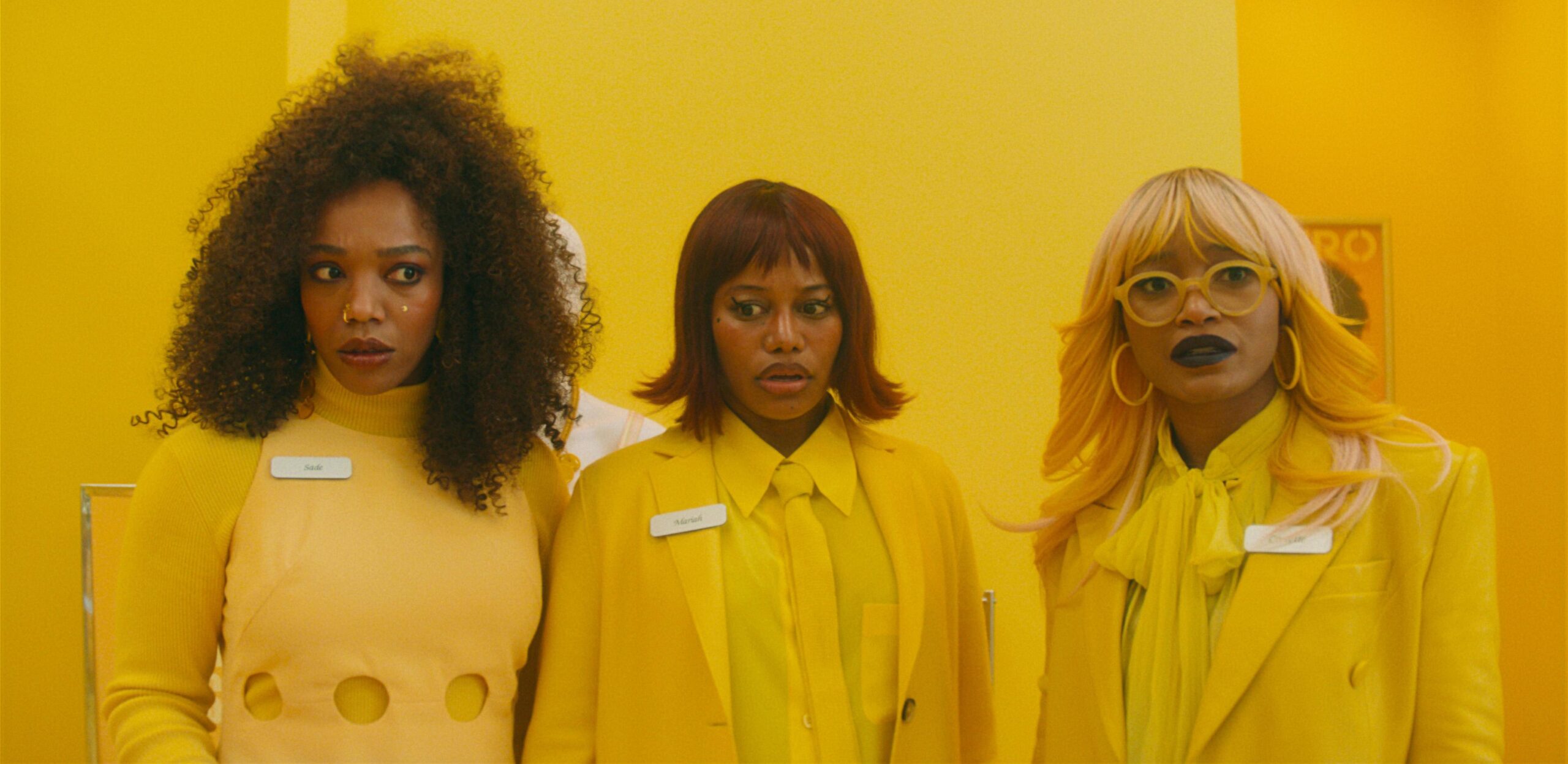
In I Love Boosters, we have a ragtag group of women who find themselves among the exploited – Corvette, in particular, later discovers that a fashion designer whom she looked up to, Christie Smith, had stolen a design of hers that she had submitted to a contest previously involving Smith. Smith’s larger-than-life persona as the leading fashion designer recalls Miranda Priestly from The Devil Wears Prada with a bit more emphasis on the stereotype of the out-of-touch white fashion designer who is oblivious to the way her clothes are made and the exploitation of human labor. Corvette and her misfit friends find themselves ‘boosting’, or in other words shoplifting clothing as much as they can and selling them off at a discounted price in order to make a living for themselves. They also keep an assortment of clothes to themselves – clearly they all have good taste, I love their outfits as well as just the colorful production design of the film in general. The Metro Design store sequences stand out in particular for their minimalist emphasis on color. It’s absolutely impractical in the context of how a fashion department business should be run but hey, it looks nice!
But while some of those technical aspects are certainly impressive, I found the CGI looked quite horrendous – almost SNL skit quality which is not something you’d want on a film at this scale, especially during the action sequences and big set pieces where the use of CG becomes very distractingly obvious. Maybe the $20 million budget was stretched as far as it could go, but I wish there was some way that these sequences could have looked better – the effects certainly were not as glaringly distracting in Sorry to Bother You.
I also found the Marxist messaging and statement here doesn’t hit quite as hard as it should. This is one of those instances where there’s clearly a lot of cool ideas that the film is playing around with, but there are probably way too many crazy ideas. There are a lot of protagonists, and we don’t really get to spend time to know each one of them and to connect with every one of them. The teleporter stuff is just… confusing to say the least, even with the double explanation. The fact that the film needs to use a visual explainer and diagram for the teleporter after a scene involving exposition delivered via Eiza Gonzalez’s character Violeta to explain how it works already shows a lack of faith in its previous attempt to explain the teleporter – also, how does Violeta know how the teleporter works? Case in point for creative idea with some shoddy execution: there’s an action set piece during the climax involving a Chinese factory and Christie’s fashion show involving the teleporters that in theory could have been very fun with some better choreography and use of those spaces. But the scene is chopped up in such a way where you never really get a proper feel for the constraints of the space both within the fashion show and the factor. The teleporter is always there to bail them out for when the characters end up in even the smallest pickle of a sticky situation. We never really feel the stakes because there is never any doubt that the characters would fail their mission to sabotage Christie Smith, there is barely any tension for what should be a climactic and meaningful sequence. It reminded me a bit of some of the wackier ideas explored in Everything Everywhere All At Once concerning jumping across time and space, but that film clearly centred itself around a particular protagonist, and that protagonist worked as the centre of gravity or anchor point to wrap its ideas around. I Love Boosters, by contrast, has no such anchor.
Once again, the whole unionizing of workers going against the big corporation is a subject matter that gets brought up again from Sorry to Bother You, but this time less effective. As much as Sorry to Bother You felt slightly on-the-nose with its political stance, there was a realness to the stakes involved even as the absurdity was dialed up with the inclusion of the wolf-human hybrids, which never felt like they interfered with our understanding of the logic of the world within the story. In I Love Boosters, the introduction of the teleporter violates our own understanding of the rules of this world whereby there wasn’t a way to bypass spacetime, to suddenly now there is. The introduction of this device means a lot of the stakes established previously prior to this revelation suddenly no longer matter now that the teleporter easily solves their problems – suddenly it is no longer about stealing clothes, but about taking down Christie Smith. It makes the anti-capitalist messaging ring a little hollow, especially when it concerns one fashion designer as the sole monopoly that matters as opposed to the collusion between corporations in Sorry to Bother You that feels a lot closer to the world in which we live in.
One last thing I will say about this is that I did enjoy Lakeith Stanfield as the demon who struggles to pick up Corvette (Keke Palmer). There is the one scene where he sucks the soul out of a lady via oral sex – it looks ridiculous, but the absurdity of that scene in terms of establishing an incompatibility between what Corvette wants (a life of pleasure that the demon cannot provide) and what the demon is looking for works quite effectively. Corvette can clearly do better than him.