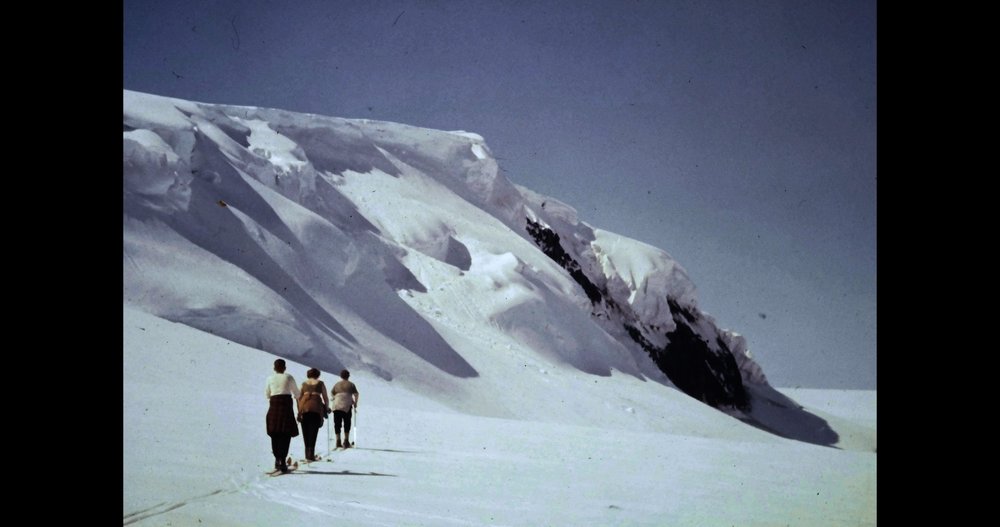
We hear the voice of Andri, a writer and a poet. He is 52 years old at the time of recording the narration for the film. Photos and home video footage of his family are presented to us, starting with his own grandparents, who both had a shared love for hiking up the glaciers along the rough Icelandic terrain. He also shares to us footage of his lovely wife and children. He warns us of climate change and its effects on the very same glaciers that his grandparents had once climbed. Something that his children may never get to experience, as there is a great chance that the glaciers may completely disappear by then. There’s a very striking overhead shot of a glacier, its white snow slowly receding into the grey rocky surface as the camera moves upwards to reveal the effects that global warming has had on the land. We also observe the very blue and icy caverns within the region, water dripping along the walls. Things will not last.
Andri also tells us about OK Glacier, which lost its glacier status in 2014 and was essentially declared ‘dead’, as the ice has receded so much and it has become so thin to the point where it’s almost as if the glacier were simply not alive. We see him stepping on the ice, which now stays static in the same place as opposed to moving as if it were ‘alive’, slowly continuing to melt away. There was even a memorial service where they installed a plaque on the site commemorating the loss, with some words from Andri himself. Even he admits it’s a strange concept to mourn the loss of a glacier, but in Iceland, one’s entire family history, the history of the land itself and the culture of the people living on the land can all be tied back to the glaciers. We are talking millions of years of history suddenly melting away and disappearing within an instant.
When the glaciers fully melt, what is left to remember our past by? Maybe our grandparents, much like Andri’s, but once they’re gone, what next? Thankfully for Andri he’s recorded quite a bit of footage of his family – the film finds Andri tending to the archives (where he once worked as an archivist) where he comes across old recordings of Icelandic folk songs that give us a glimpse into that past, as well as mention of the Library of Water that stored some of the melted glacier water in glass columns. But is that enough for us to remember this past by? Perhaps that is this entire film’s thesis – to capture a snapshot of the glaciers to be glimpsed by future generations in a world where the glaciers will no longer exist. But is this also sufficient to carry on the memory?
I admire the premise of the film – it’s ambitious, and it got me thinking a different way about my own connection to my land (Canada specifically) and how my own history is embedded to the nature of the land itself – the snow and the dense forests in particular. If there is one problem, however, it’s that the film exhausts its material about halfway through. Andri narrates to us about time again and again while we are being fed more archival footage of his family, in a way that only continues to prompt these very same ideas and subject matter regarding climate change. While the topic is very pressing and warrants attention, there is a lack of emotional resonance there in contrast to Dosa’s previous film Fire of Love, which had a wider variety of archival materials to pull from and allows us to connect with the Krafft’s mission and belief in their own love for each other. I don’t come away from this documentary knowing and understanding anything else about who Andri is besides his own connection to Iceland’s glaciers and repeatedly stressing how important his own family is to him.
It’s good to look at – the cinematography of Iceland’s geography and landscapes are beautiful, and I would certainly love to visit there someday. The film doesn’t provide much to ruminate on otherwise. But it’s also possible that the film was not meant for me to begin with in this present day when we still have some glaciers left, and when there is still an inkling of hope that they may not all completely melt, even as that hope continues to diminish over time given the way things are. Perhaps we are meant to take Andri’s words as addressed to those living in a future that may or may not have any glaciers at all to remember their history by. Hopefully the latter will not be the case.